How Much Will VR Development Cost You in 2026? A Complete Budget Guide
Virtual reality is no longer a futuristic concept reserved for experimental labs or gaming enthusiasts. It has matured into a powerful, commercially viable technology that is actively transforming industries such as enterprise training, healthcare, real estate, retail, education, and immersive entertainment. As we approach 2026, the question facing forward-thinking organizations is not whether VR is worth investing in, but how to budget for it intelligently.
The global VR market is projected to grow at a compound annual growth rate of nearly 29% between 2025 and 2032, driven by rapid hardware innovation, enterprise adoption, and the convergence of VR with AI and mixed reality. This growth signals opportunity — but it also raises complexity. Understanding VR development cost in 2026 requires more than looking at surface-level price ranges.
This guide provides a strategic, decision-maker-oriented breakdown of VR app development cost in 2026. It goes beyond simple estimates to explain what actually drives costs, where budgets expand or contract, which hidden expenses are often overlooked, and how to approach VR development as a long-term investment in experience, not just software.
The Promise and Complexity of Virtual Reality Investment
Investing in VR development is fundamentally different from building a mobile app or web platform. A VR application does not simply present information on a screen — it creates a spatial environment where users feel present, interact with digital objects, and navigate experiences using their bodies, hands, and gaze. This sense of presence is what makes VR such a powerful medium for learning, persuasion, and emotional engagement.
That same power, however, introduces significant complexity. VR development sits at the intersection of advanced engineering, 3D art, human psychology, and ergonomics. Developers must maintain high frame rates, avoid motion discomfort, design intuitive spatial interfaces, and ensure performance across different headsets. The cost of VR development reflects this multidisciplinary challenge.
Why a 2026-Specific VR Budget Guide Matters
Budget models from even two or three years ago are already outdated. The VR ecosystem is evolving rapidly, with new devices, SDKs, and user expectations redefining what “good” VR looks like. Headsets now support eye tracking, hand tracking, passthrough mixed reality, and spatial audio by default — raising both the bar for experience quality and the cost to achieve it.
A 2026-specific VR development cost guide accounts for these shifts. It helps organizations avoid under-budgeting experiences that feel outdated on launch, while also preventing over-engineering features that do not align with real business objectives. Future-proofing is no longer optional — it is part of responsible VR planning.
Core Factors Influencing VR Development Cost
There is no single “standard” VR development cost. Final budgets are shaped by several interconnected factors, each of which compounds the others. Understanding these drivers allows stakeholders to make informed trade-offs rather than reacting to unexpected cost escalations mid-project.
Application Complexity and Scope
Complexity is the single most influential factor in VR app development cost. A basic 360-degree experience with minimal interaction is fundamentally different from a multi-user simulation with AI-driven behavior and real-time analytics. As scope expands, development effort increases exponentially rather than linearly.
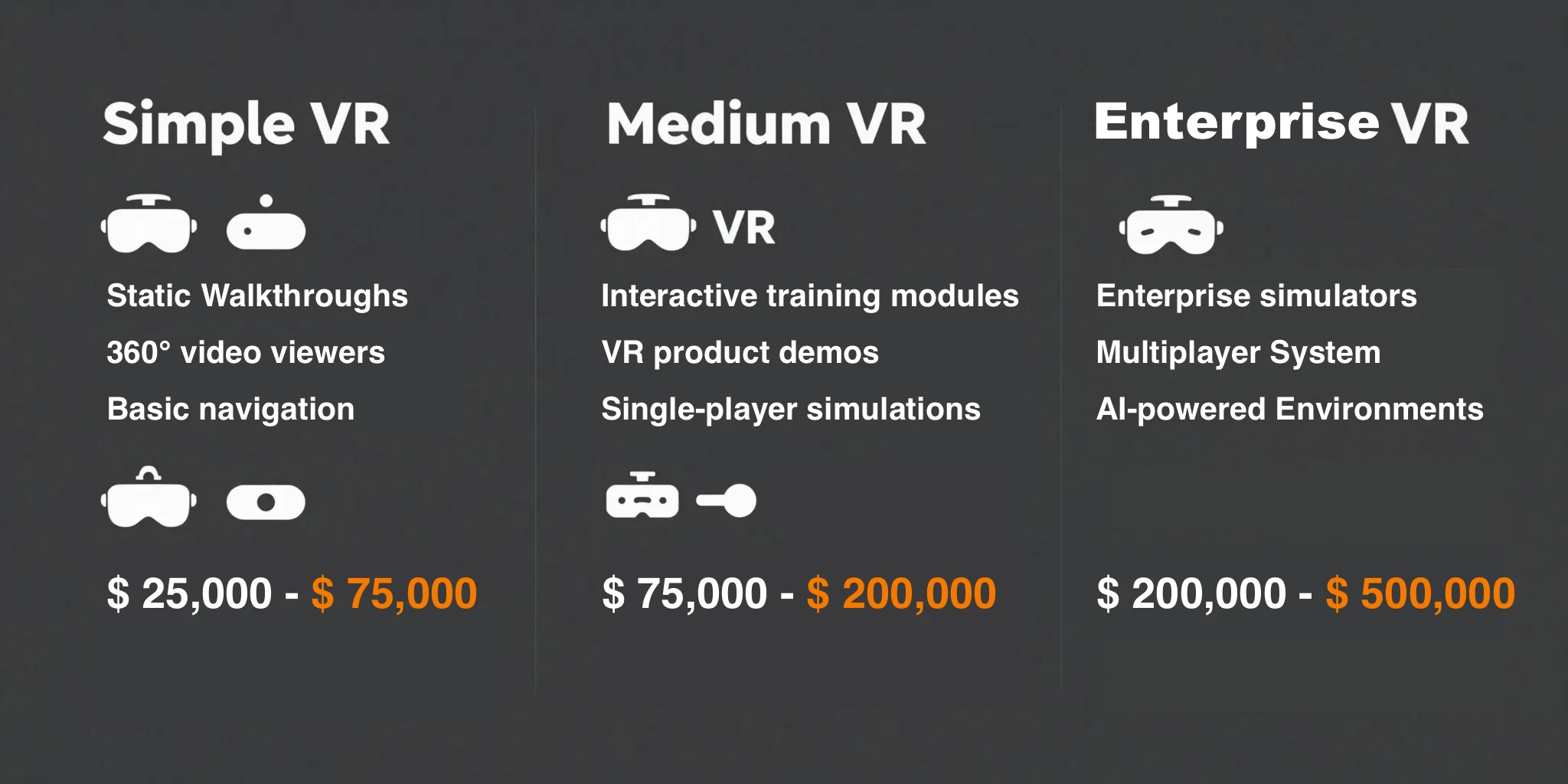
- Simple VR apps ($25,000–$75,000): Static walkthroughs, 360° video viewers, basic navigation.
- Medium-complexity VR apps ($75,000–$200,000): Interactive training modules, product demos, single-player simulations.
- High-complexity VR apps ($200,000–$500,000+): Enterprise simulators, multiplayer systems, AI-powered environments.
Platform Selection and Hardware Targets
Platform choice directly impacts VR development cost. Standalone headsets such as Meta Quest dominate the market but require aggressive optimization due to mobile-grade hardware. PC-tethered VR allows higher visual fidelity but introduces additional setup and compatibility challenges.
Premium spatial computing devices like Apple Vision Pro introduce mixed reality by default. Developing for these platforms requires advanced spatial UI design, eye- and hand-tracking integration, and extensive testing — significantly increasing both design and engineering effort.
Design and User Experience (UI/UX)
In VR, user experience is not a layer added at the end of development — it is the foundation upon which the entire product succeeds or fails. Unlike flat interfaces, VR UX must account for physical movement, spatial awareness, depth perception, and user comfort over extended sessions. Poor interaction design does not merely reduce usability; it can actively prevent adoption by causing disorientation or motion sickness.
As a result, UI/UX design typically represents one of the largest components of overall VR development cost. This includes extensive prototyping, interaction testing, locomotion experimentation, and real-user comfort validation. Businesses that attempt to minimize UX investment often incur higher costs later through rework, low engagement, or complete project resets.
The VR Development Team and Cost Implications
VR development requires a multidisciplinary team. Unlike traditional apps, it cannot be built by generalist developers alone. The quality, experience, and geographic location of the team have a direct and measurable impact on overall VR development cost.
- Project Manager
- Spatial UI/UX Designer
- 3D Artist / Animator
- Unity or Unreal VR Developer
- QA & Comfort Testing Specialist
- Sound Designer
Hourly rates vary widely by region. North America typically ranges from $100–$250 per hour, Western Europe from $80–$180, Eastern Europe from $50–$100, and regions like India from $30–$80. Many companies adopt hybrid models to balance cost efficiency with quality.
VR Development Cost by Application Category
Different use cases place different demands on realism, accuracy, scalability, and compliance. As a result, VR development cost varies significantly across industries.
Enterprise & Training VR
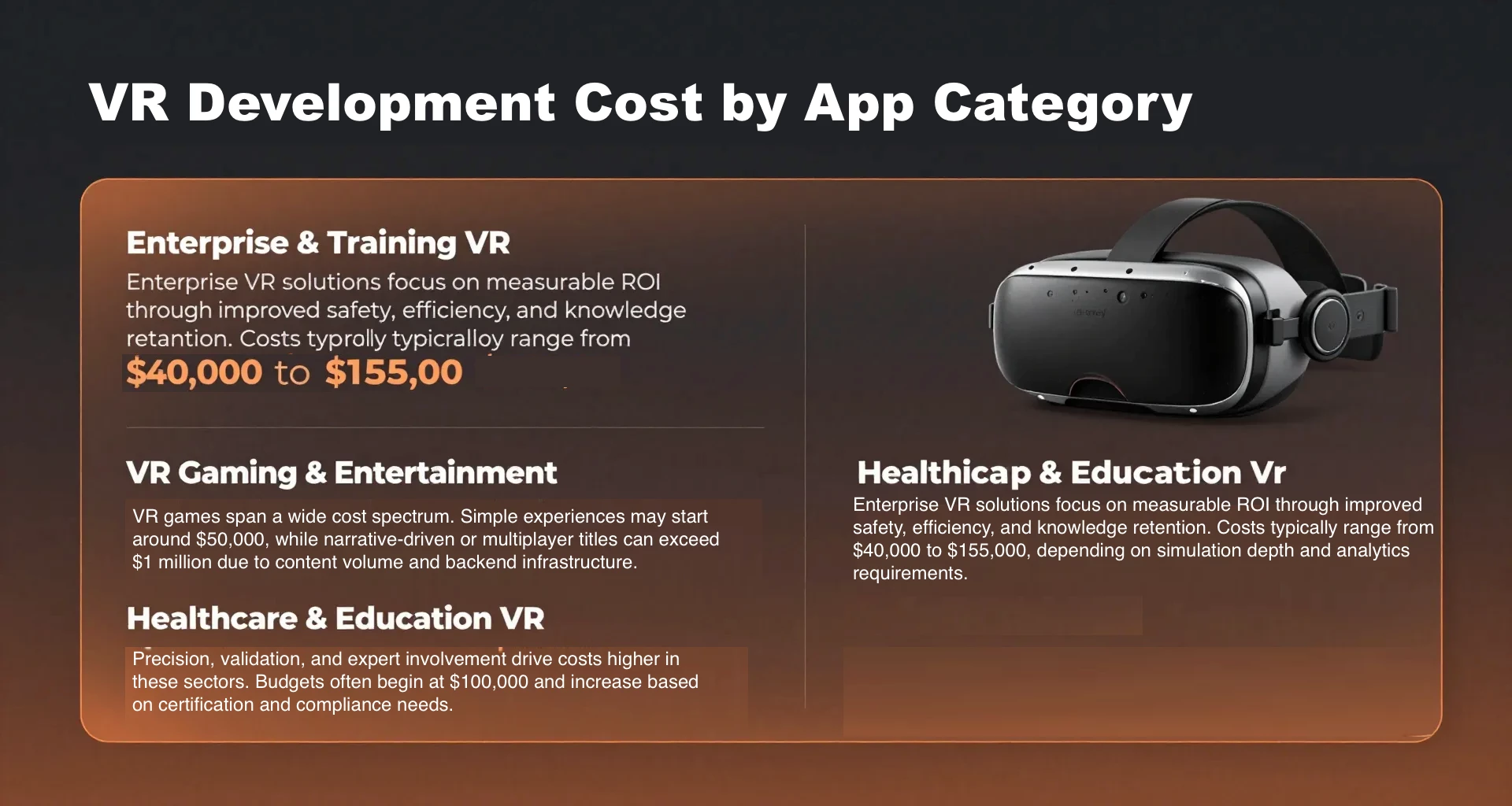
Enterprise VR solutions focus on measurable ROI through improved safety, efficiency, and knowledge retention. Costs typically range from $40,000 to $155,000, depending on simulation depth and analytics requirements.
VR Gaming & Entertainment
VR games span a wide cost spectrum. Simple experiences may start around $50,000, while narrative-driven or multiplayer titles can exceed $1 million due to content volume and backend infrastructure.
Healthcare & Education VR
Precision, validation, and expert involvement drive costs higher in these sectors. Budgets often begin at $100,000 and increase based on certification and compliance needs.
Hidden and Post-Launch VR Development Costs
VR development does not end at launch. Ongoing maintenance, SDK updates, device compatibility, and user support are recurring expenses. A realistic budget allocates 15–20% of initial development cost annually for maintenance.
Quality assurance is also more intensive in VR. Comfort testing, multi-device testing, and performance validation can account for up to 25% of total project cost — an essential investment to ensure adoption and retention.
Planning Your VR Budget with Confidence
The most successful VR initiatives begin with clarity. Defining business objectives, prioritizing experience quality, and choosing the right development partner are far more important than chasing the lowest possible quote.
If you are evaluating immersive initiatives for 2026 and beyond, working with an experienced VR development partner can help you align budget decisions with long-term impact rather than short-term savings.