
Spatial computing is no longer experimental. It’s becoming a core part of how people learn, work, shop and experience digital content. With Apple Vision Pro Development, businesses can now deliver spatial applications that blend digital content with the real world in intuitive, immersive, and memorable ways.
Atlyx helps brands design, engineer, and deploy spatial experiences built specifically for visionOS, ensuring your Apple Vision Pro apps are visually refined, highly performant, and aligned with your business objectives.
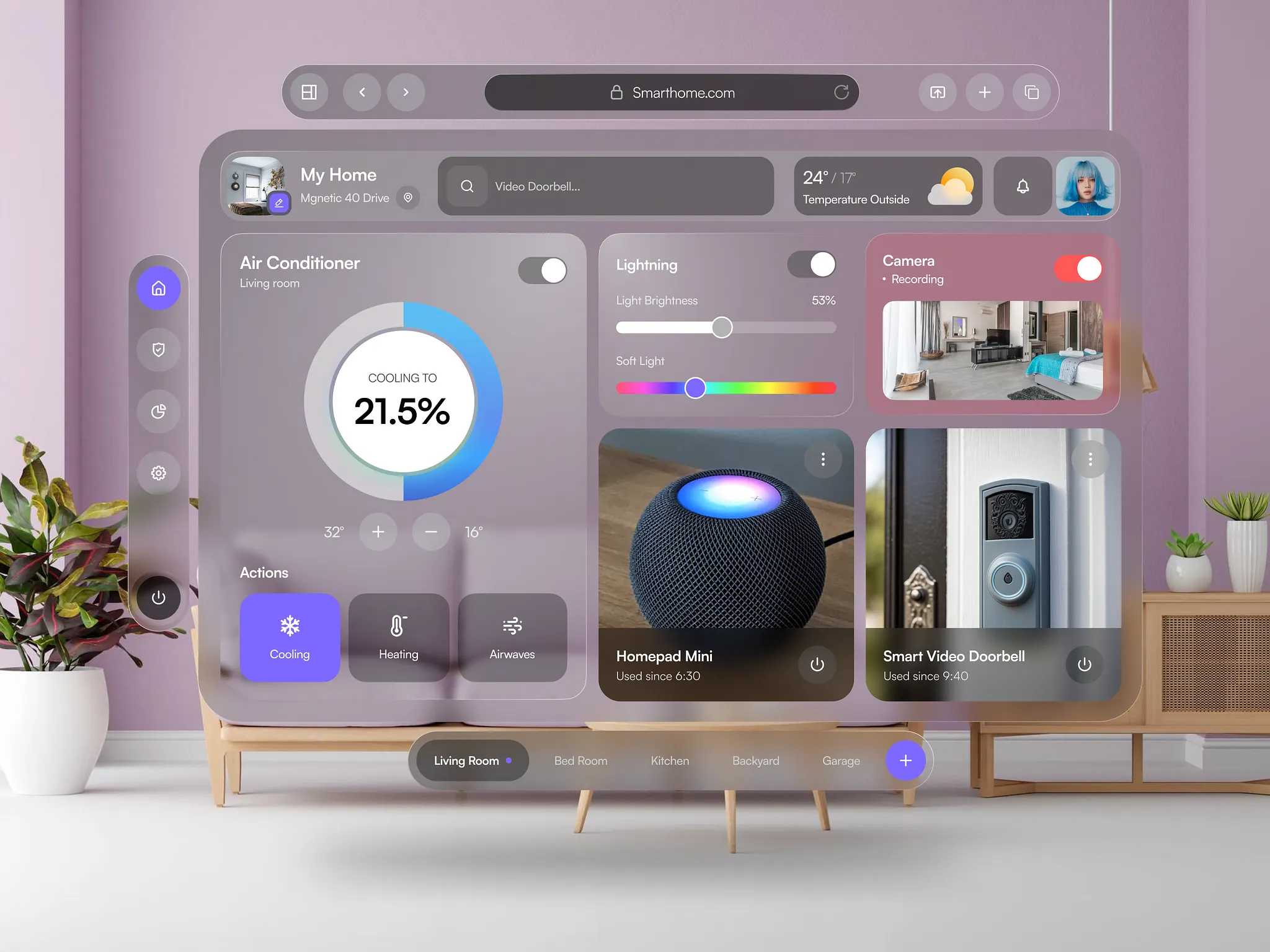
We define goals, user needs, core interactions, and the right technological approach for your Vision Pro development.
We design spatial user flows, volumetric layouts, and the complete interaction blueprint.
Our team builds UX wireframes, UI layouts, 3D environments, and interactive prototypes using spatial design principles.
We engineer your experience using RealityKit, SwiftUI, ARKit, and the latest visionOS frameworks.

We create fully custom, native visionOS applications using SwiftUI, RealityKit, spatial UI design, and advanced 3D interaction models.
Use cases include:
Spatial productivity apps
Immersive training solutions
Mixed-reality learning platforms
3D data visualization systems
Outcome: High-performance Apple Vision Pro apps built with intuitive interaction models using eye, hand, and voice input.

We design interactive, photorealistic product environments where users can explore objects in full 3D. These Vision Pro experiences help brands demonstrate products in a compelling, realistic format that boosts user engagement.
Ideal for:
Retail & shopping
Consumer electronics
Automotive
Luxury fashion
Home & interior brands
Outcome: A next-generation product discovery journey that leads to stronger customer confidence and higher conversions.

Using Apple Vision Pro Development, we build immersive simulations that make complex training safer, clearer, and more engaging.
Industries served:
Healthcare
Aviation
Manufacturing
Engineering
Education
Benefit: Spatial training increases retention, reduces risk, and offers a hands-on learning environment using mixed-reality capabilities.

If you’re at the exploratory stage, we build quick, functional prototypes or MVPs that validate your idea for Vision Pro app development.
Perfect for:
Startup founders
Product teams
Innovation labs
R&D departments
Outcome: Rapid validation of your spatial idea using a lean, iterative VisionOS prototyping process.
Retail & eCommerce
Luxury brands
Healthcare
Manufacturing
Automotive
Real Estate
Education
Media & Entertainment
Engineering & Architecture
Apple Vision Pro Development is the process of designing and building immersive applications for visionOS, Apple’s spatial operating system. Unlike traditional apps that run on flat screens, VisionOS apps exist in a 360° spatial environment. This allows businesses to create richer, more interactive experiences whether for retail, training, collaboration, entertainment, or customer engagement.
For example, retail brands can build interactive virtual showrooms, enterprises can create spatial collaboration tools, and education providers can develop immersive learning modules.
Businesses that adopt Vision Pro early gain a competitive edge by offering experiences that are more intuitive, visually appealing, and memorable.
For more on spatial computing fundamentals, you can review Apple’s official documentation:
If you’re exploring similar immersive solutions beyond Vision Pro, you can also see our page on Immersive Experience Development
Not necessarily. Apple Vision Pro can display iPhone and iPad apps in compatibility mode, meaning your existing app can run without modification. However, compatibility mode does not take advantage of spatial features like volumetric UI, gesture-based interactions, or immersive 3D environments.
If you want users to feel the experience instead of just viewing it, then a redesign is strongly recommended. Spatial computing requires rethinking layout, depth, interaction, and visual hierarchy.
For instance:
A standard shopping app becomes a 3D product exploration studio
A learning app becomes an interactive learning room with spatial cues
A fitness app becomes an immersive training zone with real-time feedback
If you’re unsure which direction is right for you connect with us to discuss more.
The development timeline depends on project scope, content complexity, interaction depth, and required integrations. On average:
Prototypes/MVPs: 4–8 weeks
Mid-level apps (training, showroom, demos): 12–16 weeks
Full enterprise-grade Vision Pro apps: 4–6 months or more
Key factors affecting timelines include:
Custom 3D model creation
Spatial UI/UX requirements
Real-time interaction mechanics
Multi-user collaboration features
Backend/API integrations
Data visualization requirements
If you’re building a customer-facing retail experience, development is usually faster compared to building a real-time collaborative engineering tool.
Our VisionOS development process combines design, engineering, and advanced 3D creation. We use:
SwiftUI — Apple’s UI layer for VisionOS
RealityKit & ARKit — for rendering, physics, gestures, volumetric scenes
Unity & Unreal Engine — when high-fidelity 3D environments are required
Reality Composer Pro — for building and testing spatial scenes
Spatial Audio frameworks — for immersive audio design
visionOS APIs — hand tracking, eye input, 3D windows, shared spaces
For large environments, training systems, or product demo pipelines, you can also explore our 3D Visualization Services
Apple Vision Pro Development has broad applicability across industries due to its ability to blend physical and digital experiences. Key beneficiaries include:
Retail & eCommerce – 3D product interaction, virtual stores
Automotive – car configurators, virtual test drives
Healthcare – simulation-based medical training
Manufacturing – workflow training, safety simulations
Education – immersive classrooms and spatial labs
Real Estate – walkthroughs, interior visualization
Entertainment & Media – interactive storytelling
Enterprise – spatial productivity apps and dashboards
Architecture & Engineering – 3D model reviews, collaboration
If you fall into any of these categories, explore our Industry Experience library
Yes, and most companies begin with a Vision Pro MVP before building a full-scale product. An MVP allows you to:
Validate the concept with real users
Test spatial interactions and usability
Secure stakeholder support or investor funding
Understand feasibility before full investment
Gather performance analytics early
Typical MVP outputs include:
Interaction prototypes
Spatial UI mockups
3D environment tests
Limited-feature demos
Proof-of-technology builds
Costs vary based on complexity, 3D asset requirements, interaction depth, and integrations. Rough ranges:
Basic MVP: $10,000–$35,000
Interactive product demos: $30,000–$80,000
Training/Simulation apps: $50,000–$150,000
Enterprise-grade platforms: $120,000–$300,000+
Cost drivers include:
High-fidelity 3D modeling
Custom environments
Multi-user interactions
Advanced physics simulation
AI or backend integrations
Real-time data streaming
For accurate testing, you will need:
An Apple Vision Pro device
A Mac with the latest Xcode
Apple’s visionOS Simulator
Optional: Unity or Unreal environment setup
Spatial audio testing hardware (if applicable)
The VisionOS Simulator can emulate many scenarios, but real-device testing is critical for:
Gesture accuracy
Depth perception
Lighting conditions
Spatial alignment
Environment scaling
More hardware guidance is available in Apple’s developer docs
Yes. VisionOS apps can integrate with:
REST/GraphQL APIs
Authentication systems
Product databases
E-commerce platforms
LMS or training systems
IoT and sensor data
ERP/CRM systems
If you already have digital infrastructure, we can extend it into VisionOS without disrupting your existing workflows.
Ready to turn heads into Spatial 3d experiences?